P3074
Water: Sink to Sea
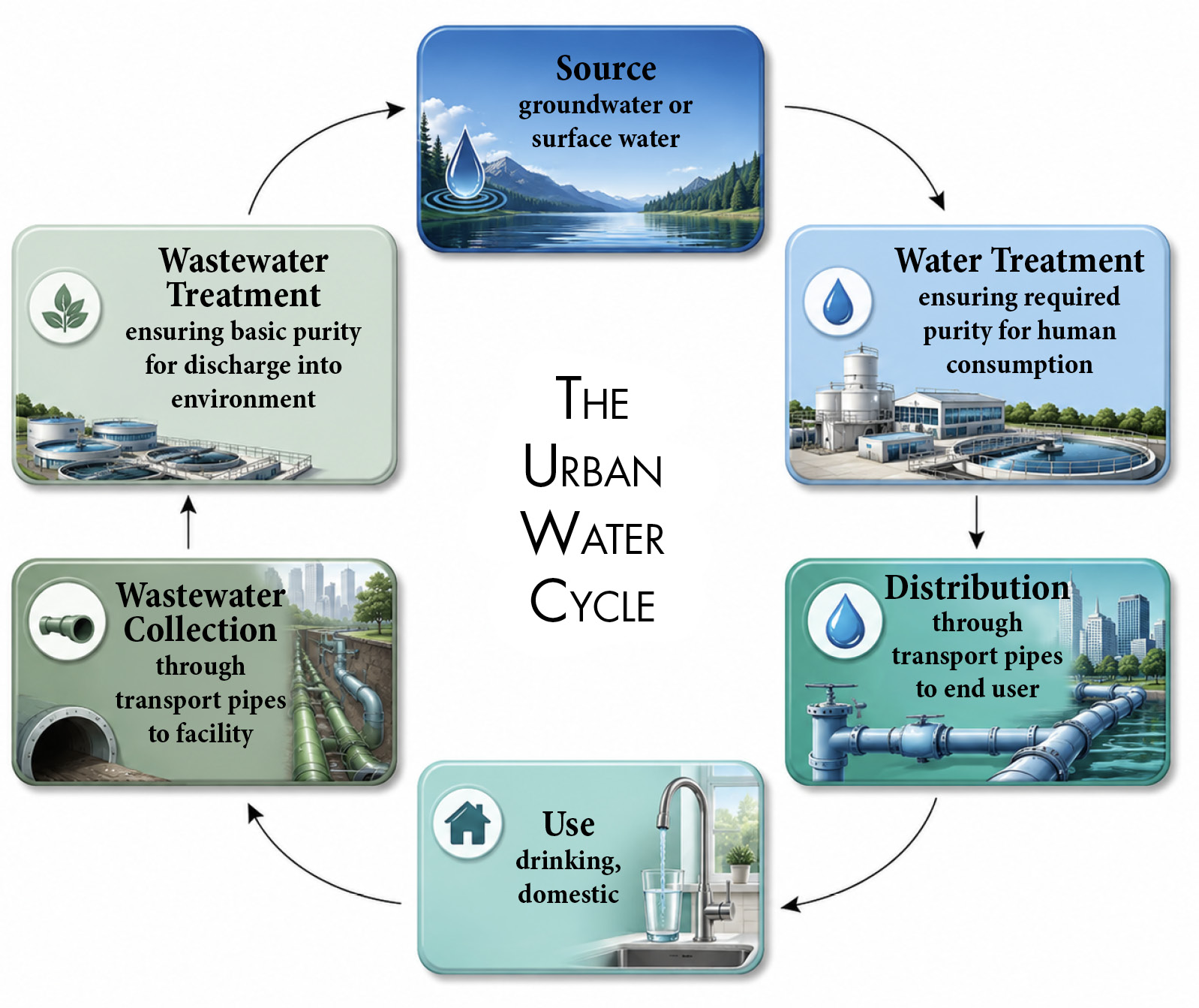
To understand how humans interact with water, you need to understand the water, or hydrologic, cycle, which is the continuous movement of water through the atmosphere, land, surface waters, and groundwater. Describing the water cycle also requires a firm understanding of how humans interact with and have altered the water cycle. This dramatic alteration is especially evident within cities where natural hydrologic processes are changed. The hydrologist Robert B. Sowby termed this engineered system the urban water cycle (Figure 1). Fifty-four percent (3.5 billion) of the world’s population live in cities, and this number is expected to grow to more than 65 percent by 2050. In the United States, 62.7 percent of the population live in cities.
Growing urban populations put pressure on public water systems and create major challenges for securing ample clean water for the future. Whether for drinking water, domestic uses, food production, transportation, or manufacturing, humans rely on water for many basic needs and widespread conveniences. Understanding how humans interact with and impact the water cycle is the first step in protecting our water resources.
Urban Water Cycle
In the natural water cycle, water moves between continuous processes of evaporation, transpiration, condensation, precipitation, runoff, infiltration, and surface and groundwater exchange. Some of the transport processes can take a very long time to occur. Aquifers, for example, recharge via precipitation that infiltrates the soil and geological profile, which can take decades to centuries. Humans impact water resources by altering the transport pathways and moving water resources between storage compartments at rates that are faster than natural rates. Other impacts include introducing often-harmful contaminants that are unlikely to occur in natural water systems.
Let’s take a look at some major components of the urban water cycle, how humans interact with water in the cycle, and ways we can do our part to ensure human and environmental safety.
- Source: groundwater or surface water
- Water Treatment: ensuring required purity for human consumption
- Distribution: through transport pipes to end user
- Use: drinking, domestic
- Wastewater Collection: through transport pipes to facility
- Wastewater Treatment: ensuring basic purity for discharge into environment
Municipal Water Sources and Pretreatment
Household water comes from surface and/or groundwater sources. Surface water sources include lakes, reservoirs, and rivers—these are the most visible and are often tapped for public water supplies. Groundwater is found beneath the earth’s surface and is another primary source of water for human use. Many factors influence which type of water source is used to meet human demands, including accessibility, quality, availability, proximity, economics, and legality.
Water resources for public supply systems are typically treated before distribution for human use. Treatment ensures the removal of harmful contaminants and pathogens. Some homes have private wells that pull groundwater for domestic use, such as for drinking; groundwater is typically safe for drinking directly from the source.
Water is transported from a surface or groundwater source to a water-treatment facility, where sediment and harmful microorganisms are removed. Disinfection is an important step that kills harmful microorganisms in water. Additional treatment steps are necessary or desired; these include a sequence of screening, settling, filtering, disinfecting, and making chemical adjustments to reduce health risks and improve water taste and odor. Once treated, water is distributed right to customers’ taps through public water supply pipes (distribution system) belowground.
Wastewater Treatment
After we use water, whether for bathing, watering the lawn, cooking, or flushing the toilet, it all goes down the drain. But then where does it go? In a similar fashion to water distribution, wastewater collection systems transport water from customers through sewer pipes to wastewater-treatment facilities. This system often includes storm drain systems (i.e., combined sewer overflows) that collect surface water runoff and transport it to facilities along with customer wastewater. It should be noted that some modern separated stormwater systems direct precipitation runoff through a dedicated municipal separate storm sewer system (MS4), which discharges runoff directly into local waterways.
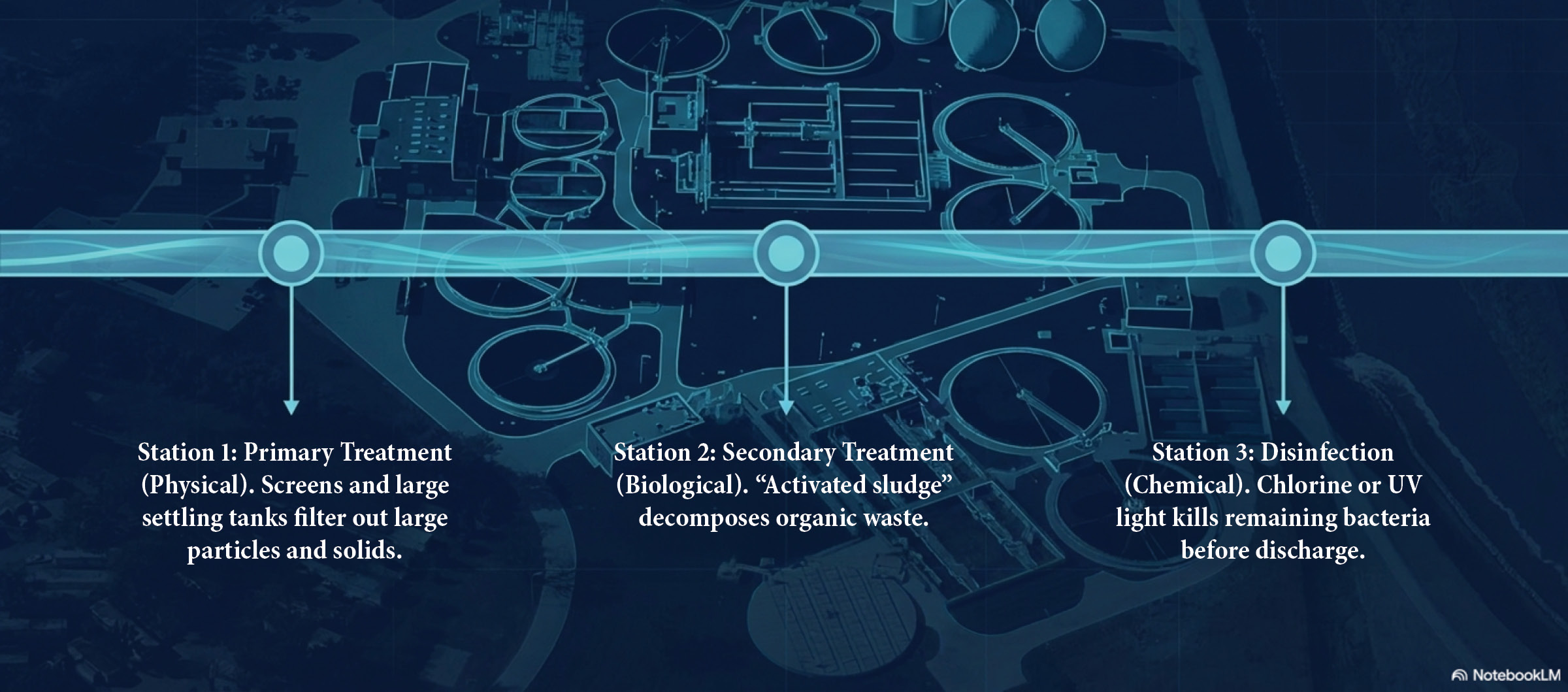
A wastewater-treatment facility (or plant) consists of multiple structures, designed specifically to manage and treat human waste, solid waste, sewage, and stormwater—collectively referred to as wastewater. Wastewater must go through a treatment process before it can be discharged into the environment. Wastewater treatment consists of physical, biological, and chemical treatment (Figure 2) processes to remove waste and ensure that acceptable water is released into the environment.
The first step in the wastewater-treatment process is primary treatment of solids and large particles that are filtered out of the water using screens and large settling tanks. Once large particles are removed, the wastewater still contains small organic particles, suspended solids, and chemical and biological contaminants that need to be removed.
Next is secondary treatment, which is a biological treatment process where bacteria and other microorganisms are used to reduce organic matter through decomposition in a process referred to as activated sludge. The activated sludge process uses larger tanks with aeration and mixing apparatuses followed by a settling pond to separate the liquid and solids. Solids are then either composted on-site or transported and disposed of in a nearby landfill. While landfills are an important component in the current waste-management system, the waste in landfills is a source of air and groundwater pollution. To remediate this issue, some municipalities use composting to create methane gases that run generators and help to power the treatment plant.
To complete the secondary treatment, water is disinfected using chlorine or ultraviolet light to kill bacteria before being discharged into receiving waters. Some municipalities use constructed treatment wetlands as a method either to improve water quality coming into the plant or further treat water leaving the plant. Cleaned water is released back into surface waters and re-enters the hydrologic cycle.
Septic Systems
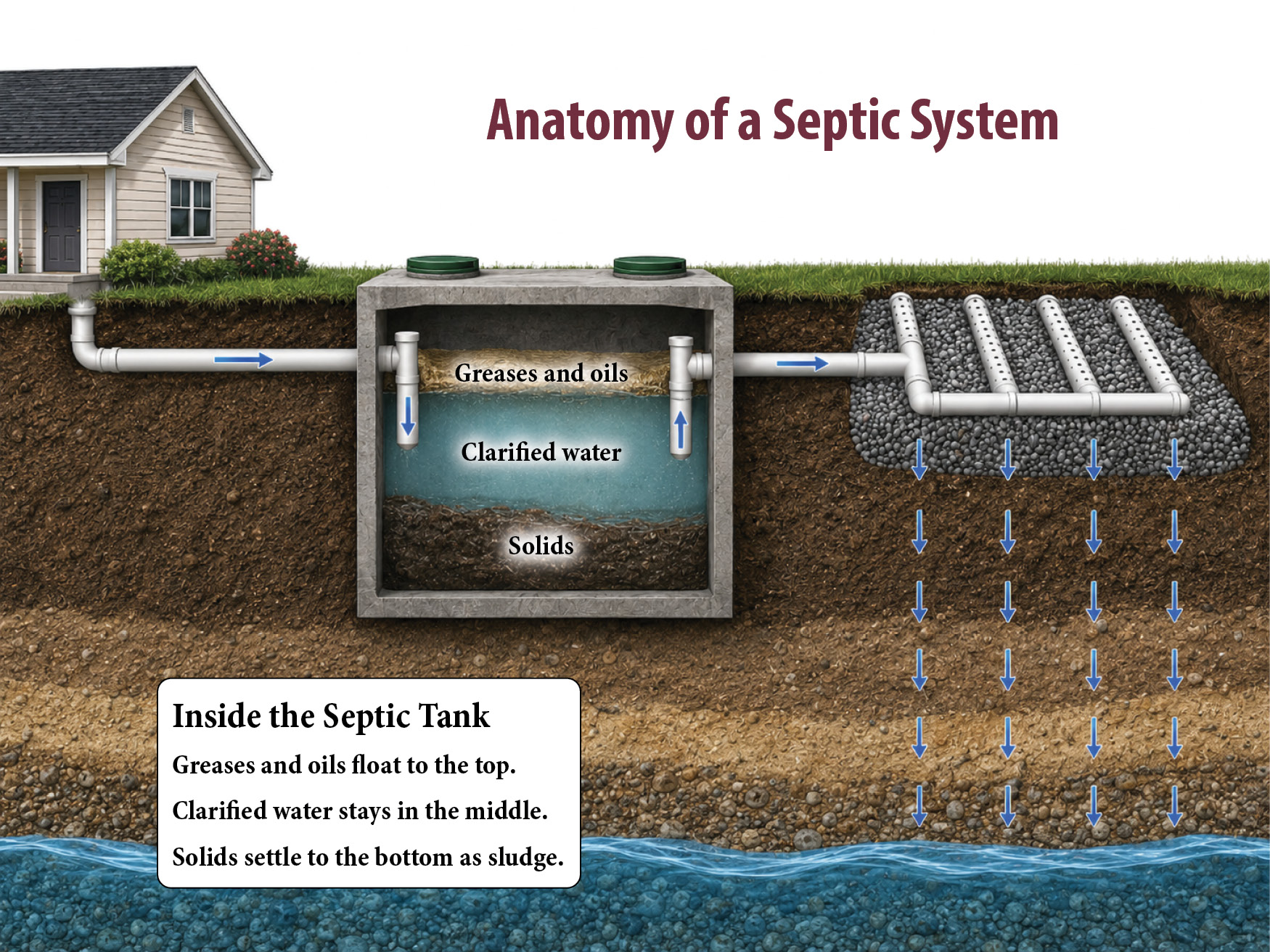
For homeowners with on-site waste-treatment systems or septic systems, the treatment process is a bit different. A septic system is an underground waste-treatment system used in rural areas where centralized public systems are less economical or not logistically feasible. A septic system has two main parts: a septic tank and a drainfield (Figure 3). The septic tank is a sealed container that receives waste flows from the home and holds them long enough for solids and liquids to separate.
The waste separates into three layers: greases and oils float to the top, solids settle to the bottom, and partially clarified water remains in the middle layer. The clarified liquid layer flows out of the holding tank into the drainfield, or into distribution devices that disperse the water into the drainfield. A drainfield can be a series of trenches or a bed lined with gravel or coarse sand buried 1–3 feet below the ground surface. Water pumped into the drainfield moves through the gravel and soil, which act as a biological filter to clean the water. This is similar to the natural water filtration process.
Figure 3. A septic tank is a sealed container where household wastewater is held to separate solid wastes (at the bottom as sludge) from grease and oil (rises to the top) from clarified water (in between the top and bottom layers). Clarified water moves out of the tank, into a drain field, and percolates into deeper sedimentary layers that filter additional pollutants before reaching groundwater. Illustrative image created using generative AI.
Anatomy of a Septic System
Inside the Septic Tank
- Greases and oils float to the top.
- Clarified water stays in the middle.
- Solids settle to the bottom as sludge.
Infrastructure and Stormwater Management
Wastewater-treatment systems are crucial for maintaining public health and sanitation and for reducing environmental impacts to receiving waters. However, these systems are a source of greenhouse gas emissions and require important physical-structure maintenance and technology upgrades over time. Due to the physical infrastructure required for a facility, they are often designed to process a specific amount of waste per day, based on the population the facility is intended to serve. This can be problematic as urban populations continue to grow.
The estimated total cost of wastewater and stormwater treatment and collection in the U.S. was $271 billion as of January 1, 2012. That estimate includes capital needs for publicly owned wastewater pipes and treatment facilities ($197.8 billion), combined sewage overflow correction ($48 billion), stormwater management ($19.2 billion), and recycled water treatment and distribution ($6.1 billion). The growing need and cost of water infrastructure require citizen knowledge of and engagement in local water protection efforts. In addition, coordinated support across local, state, and federal funding mechanisms will enhance the efficacy of resource allocations. In some regions of the U.S., public-private water conservation partnerships and water quantity and quality trading mechanisms are leveraging additional resources for water protection.
References
- City of Lincoln, Nebraska. Lincoln Wastewater System. Retrieved February 16, 2017.
- Rhodan, M. 2013. U.N.: Number of City-Dwellers to Double by 2050. Retrieved May 11, 2017.
- Snohomish County, Washington. “Septic Systems.” Retrieved February 16, 2017.
- Sowby, Robert B. 2014. “The Urban Water Cycle: Sustaining Our Modern Cities.” National Geographic. Retrieved February 16, 2017.
- United Nations. 2014. World’s population increasingly urban with more than half living in urban areas. U.N. Department of Economic and Social Affairs. Retrieved May 11, 2017.
- U.S. Census Bureau. 2015. U.S. Cities Home to 62.7% of Population but Comprise 3.5% of Land Area. Retrieved February 17, 2017.
- U.S. Environmental Protection Agency. 2012. Clean Watersheds Needs Survey 2012: Report to Congress. Retrieved February 16, 2017.
Publication 3074 (POD-08-26)
Revised by Beth Baker, PhD, Associate Professor, and Mark Hill, Extension Associate I, Wildlife, Fisheries, and Aquaculture, from the original by Beth Baker, Austin Omer, former Extension Associate, and Caleb Aldridge, former Research Associate, Wildlife, Fisheries, and Aquaculture. Generative artificial intelligence (AI) was used to create or refine illustrative images in this publication. All technical content was developed, reviewed, and approved by the authors.
The Mississippi State University Extension Service is working to ensure all web content is accessible to all users. If you need assistance accessing any of our content, please email the webteam or call 662-325-2262.
Download
P3074
Water: Sink to Sea
640.21 KB
Departments
Authors
-
 Assoc Professor & Assistant Di
- Wildlife, Fisheries & Aquaculture
-
 Extension Associate I
- Wildlife, Fisheries & Aquaculture