P4192
Trees for Pasture-Based Livestock Systems in the Southeastern U.S.
Download the full publication by selecting the publication image in the right column.
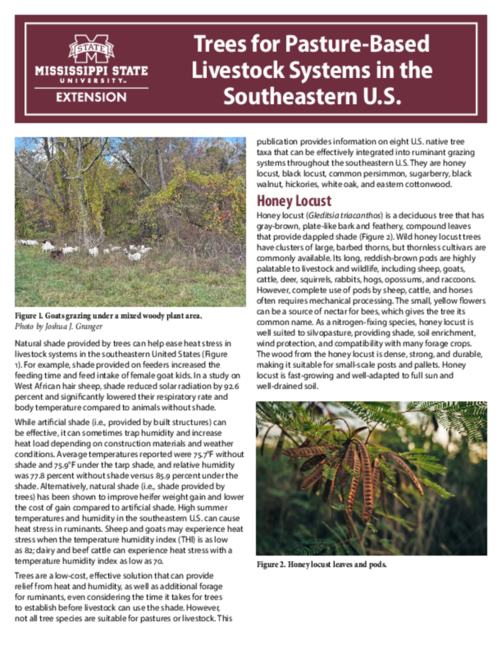
Natural shade provided by trees can help ease heat stress in livestock systems in the southeastern United States (Figure 1). For example, shade provided on feeders increased the feeding time and feed intake of female goat kids. In a study on West African hair sheep, shade reduced solar radiation by 92.6 percent and significantly lowered their respiratory rate and body temperature compared to animals without shade.
While artificial shade (i.e., provided by built structures) can be effective, it can sometimes trap humidity and increase heat load depending on construction materials and weather conditions. Average temperatures reported were 75.7°F without shade and 75.9°F under the tarp shade, and relative humidity was 77.8 percent without shade versus 85.9 percent under the shade. Alternatively, natural shade (i.e., shade provided by trees) has been shown to improve heifer weight gain and lower the cost of gain compared to artificial shade. High summer temperatures and humidity in the southeastern U.S. can cause heat stress in ruminants. Sheep and goats may experience heat stress when the temperature humidity index (THI) is as low as 82; dairy and beef cattle can experience heat stress with a temperature humidity index as low as 70.
Trees are a low-cost, effective solution that can provide relief from heat and humidity, as well as additional forage for ruminants, even considering the time it takes for trees to establish before livestock can use the shade. However, not all tree species are suitable for pastures or livestock. This publication provides information on eight U.S. native tree taxa that can be effectively integrated into ruminant grazing systems throughout the southeastern U.S. They are honey locust, black locust, common persimmon, sugarberry, black walnut, hickories, white oak, and eastern cottonwood.
You can also contact state Extension specialists or your local Extension office for answers to specific questions.
Publication 4192 (POD-05-26)
By Leyla Rios, MSc, PhD, Assistant Professor, Animal and Dairy Sciences, Joshua J. Granger, PhD, Associate Professor, Forestry, and Ashley N. Schulz, PhD, Assistant Professor, Forestry. Reviewed by Miguel Castillo, PhD, North Carolina State University, and Nicholas Tyre, Virginia Tech.
The Mississippi State University Extension Service is working to ensure all web content is accessible to all users. If you need assistance accessing any of our content, please email the webteam or call 662-325-2262.
Download
P4192
Trees for Pasture-Based Livestock Systems in the Southeastern U.S.
2.95 MB
Departments
Authors
-
 Assistant Professor
- Animal & Dairy Science