M2480-06
Preserve It, Don’t Waste It: The Money-Saving Power of Canning
Challenges
- Food waste is a major global issue, with approximately 1.3 billion tons of food wasted each year. In the U.S. alone, nearly 30–40% of the food supply is wasted annually. In 2022, around 1.05 billion tons of food were wasted post-production—households alone accounted for 631 million tons, or about 60% of that total.
- To combat food waste, people are embracing home canning, but key challenges come with this desire:
- Canning can be labor- and time-intensive, especially for beginners.
- Proper canning techniques are required to avoid botulism.
- Processing food safely requires proper equipment and ample time to prep, cook, and process foods.
Extension Response
- In 2023, about 31% of the U.S. food supply (out of 237 million tons) went unsold or uneaten; 63 million tons ended up as waste, accounting for roughly 1.4% of U.S. GDP.
- Extension agents educate home canners on proper canning techniques to avoid food waste and possible food-borne illnesses.
- In 2023 and 2024, Extension agents conducted vegetable canning programs with 738 participants in 18 counties.
- During these programs, Extension agents highlight the benefits of investing time in home canning versus buying from the grocery store. They explain how to save money by purchasing in-season produce in bulk from local sources like farmers markets, co-ops, or directly from farms—where prices are lowest and quality is highest.
- Agents also inspect participants’ canners for faulty gaskets and use a master gauge to pressure-test equipment, ensuring it is safe and ready for use.
Economic Impacts
- Cutting food waste through canning alone saves an average U.S. household over $2,000 annually. By preventing premature decay and enabling long-term storage, canning plays a vital role in minimizing food loss at both the household and commercial levels.
- Canning combats food waste by significantly extending the shelf life of perishable foods—up to 1–5 years or more—reducing spoilage, preserving surplus harvests, and allowing off-season consumption.
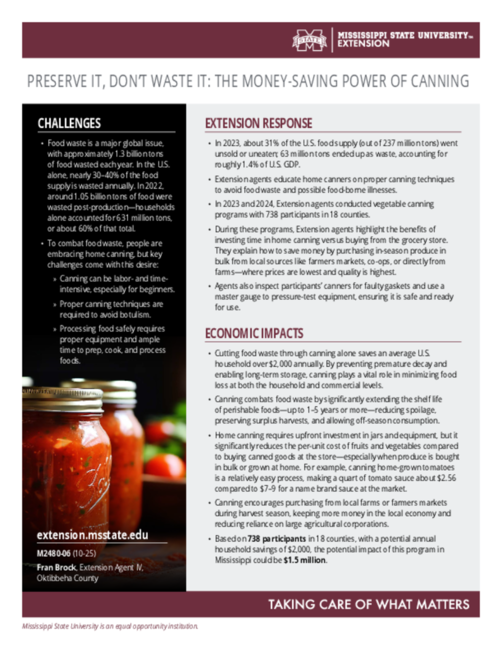
- Home canning requires upfront investment in jars and equipment, but it significantly reduces the per-unit cost of fruits and vegetables compared to buying canned goods at the store—especially when produce is bought in bulk or grown at home. For example, canning home-grown tomatoes is a relatively easy process, making a quart of tomato sauce about $2.56 compared to $7–9 for a name brand sauce at the market.
- Canning encourages purchasing from local farms or farmers markets during harvest season, keeping more money in the local economy and reducing reliance on large agricultural corporations.
- Based on 738 participants in 18 counties, with a potential annual household savings of $2,000, the potential impact of this program in Mississippi could be $1.5 million.
M2480-06 (10-25)
Fran Brock, Extension Agent IV, Oktibbeha County
The Mississippi State University Extension Service is working to ensure all web content is accessible to all users. If you need assistance accessing any of our content, please email the webteam or call 662-325-2262.
Download
M2480-06
Preserve It, Don’t Waste It: The Money-Saving Power of Canning
180.23 KB
Authors
-
 Extension Agent IV*
- MSU Extension- Oktibbeha County