P3440
A Photo Guide to Whitefly-transmitted and Yellowing Viruses in Watermelon and Other Cucurbit Crops
Download the PDF for the photos described below.
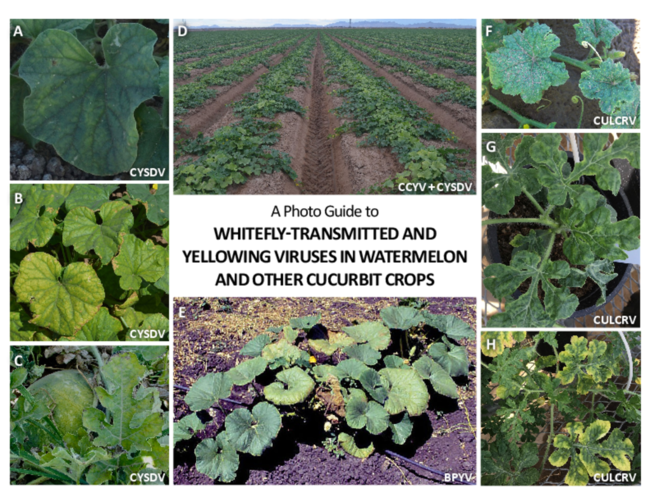
Photos: Symptoms of whitefly-transmitted and yellowing viruses in cucurbits and their insect vectors.
(A–C): Cucurbit yellow stunting disorder virus (CYSDV). Green-yellow mottle (A) and interveinal chlorosis (B) are visible in early and more advanced stages, respectively, of melon leaves infected with CYSDV. Foliar yellowing is visible on watermelon leaves infected with CYSDV (C).
(D–E): Cucurbit chlorotic yellows virus (CCYV), beet pseudoyellows virus (BPYV), and CYSDV. Chlorosis often begins near the crown of plants and progresses outward down leaves in hosts infected with BPYV, CCYV, and CYSDV. Chlorosis on leaves near the crown is visible down the center of rows in a melon field with plants infected with both CCYV and CYSDV (D) and in a pumpkin plant infected with BPYV (E).
(F–H): Cucurbit leaf crumple virus (CuLCrV). Leaf crumpling and mottle as shown in melon (F) and watermelon (G–H) are common symptoms in cucurbits infected with CuLCrV.
(I): Cucurbit aphid-borne yellows virus (CABYV). Interveinal yellowing and symptom spread down vines are advanced symptoms of CABYV as seen in bottle gourd (I). CABYV symptoms look nearly identical to those of BPYV, CCYV, and CYSDV.
(J–L): Squash vein yellowing virus (SqVYV). Vein yellowing, as seen in zucchini, is a common symptom in most commercially produced cucurbit crops (J). Leaf and vine collapse are common symptoms in watermelon infected with SqVYV (K). Watermelon fruit with internal rind necrosis (black arrows), caused by SqVYV infection, is often not marketable (L).
(M–P): Insect vectors of yellowing viruses in cucurbits. The sweetpotato whitefly (Bemisa tabaci, M–N) is the vector of CCYV, CuLCrV, CYSDV, and SqVYV. The greenhouse whitefly (Trialeurodes vaporariorum, O) is a vector of BPYV. The wings of sweetpotato whitefly adults (M) are angled over their body like the roof of a house and have a gap between them. The wings of greenhouse whitefly adults (O) are more horizontal and overlap one another. The nymphs of the sweetpotato whitefly (N) are oval-shaped and smooth, whereas the nymphs of the greenhouse whitefly (O) have hair-like projections. The melon aphid (Aphis gossypii, P) is one of several aphid species known to vector CABYV.
Many whitefly-transmitted viruses, as well as some viruses transmitted by other vectors, produce similar yellowing symptoms in cucurbit crops. The specific symptoms associated with virus infections vary by virus and to some degree by crop. Images alone cannot be used to obtain an accurate diagnosis. For more information on these viruses, see MSU Extension Publication 3439 Whitefly-transmitted and Yellowing Viruses in Watermelon and Other Cucurbit Crops.
Photo credits: (A–E, I–J) W. M. Wintermantel, USDA-ARS; (F) R. L. Gilbertson, University of California-Davis; (G–H) M. R. Rojas, University of California-Davis; (K–L) S. Adkins, USDA-ARS; (M–N) D. Riley, University of Georgia, Bugwood.org; (O) W. Cranshaw, Colorado State University, Bugwood.org; (P) M. B. Layton, MSU Extension.
Publication 3440 (04-26)
Rebecca A. Melanson, PhD, Assistant Extension Professor, Plant Pathology, Mississippi State University Central Mississippi Research and Extension Center; William M. Wintermantel, PhD, Research Plant Pathologist, USDA-ARS; Edward J. Sikora, PhD, Professor and Extension Plant Pathologist, Alabama Cooperative Extension System, Auburn University; and Raghuwinder Singh, DPM, Associate Professor and Director of the Plant Diagnostic Center, Louisiana State University Agricultural Center.
The Mississippi State University Extension Service is working to ensure all web content is accessible to all users. If you need assistance accessing any of our content, please email the webteam or call 662-325-2262.
Download
P3440
A Photo Guide to Whitefly-transmitted and Yellowing Viruses in Watermelon and Other Cucurbit Crops
2.2 MB
Departments
Authors
-
 Associate Extension Professor
- Central MS Research & Ext Center