P2426
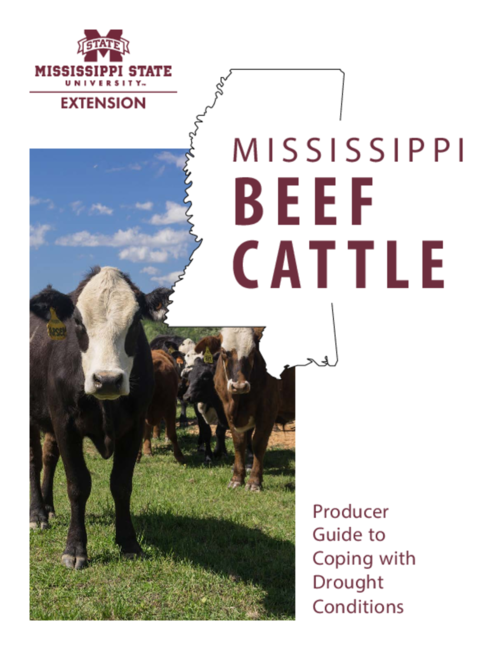
Mississippi Beef Cattle Producer Guide to Coping with Drought Conditions
Drought on Mississippi Cattle Operations
Beef production is a significant component of Mississippi agriculture. The total value of production of cattle and calves in Mississippi is estimated at $482 million for 2024. Total cattle inventory in Mississippi on January 1, 2025, was 810,000 head, including 430,000 cows and heifers that have calved. The calf crop for the full year of 2024 was 345,000 head. This remains the same from January 1, 2024. There were 13,631 beef cattle farms in 2024. Stocker cattle production is also very prominent with 400,000+ head of stocker cattle residing in the state annually.
This publication was written to give Mississippi beef producers information on drought-coping options and related knowledge to assist them in making profitable production and marketing decisions. Drought can be expected as part of normal production cycles. The overall cattle operation management plan should include drought preparation and coping plans. Extended periods of dry weather create management challenges for both cow-calf and stocker operations. Droughty conditions greatly impact pasture and hay land productivity, as well. Because most Mississippi beef operations are heavily dependent on forage-based nutritional programs, nutritional concerns often become a focal point of cattle production systems during periods of drought-induced poor forage productivity and supplies.
The Mississippi office of the National Agricultural Statistics Service publishes a weekly weather crop report. This report details pasture and hay conditions as excellent, good, fair, poor, or very poor with percentages of the state crop rated in each of these categories. This report provides an overall summary of statewide pasture and hay conditions, yet local conditions can vary dramatically across the state. While the local precipitation situation is of most concern to individual producers, statewide, regional, and even national precipitation, soil moisture, and crop conditions impact supply and demand for inputs and marketing from Mississippi beef operations. The U.S. Drought Monitor tracks current drought conditions and impacts on a national scale.
Widespread drought has a number of implications for the cattle market. First of all, the intensity of a drought in major cattle-producing states like Texas and Oklahoma makes it difficult to expand the national beef herd. Many producers find it difficult to maintain the herd they have, much less consider increasing cattle numbers. The drought may not halt herd expansion altogether, but it will, at the very least, slow the pace of expansion, thus affecting the level of beef production further down the road. Longer term, a reduction in beef production will be supportive of cattle prices. In the short run, forced sales of increasing numbers of cattle will not be good for prices, certainly not at the local market level.
Looking more specifically at stocker and feeder cattle markets, a current drought could affect both supply and demand for calves. On the demand side, drought impacts on winter grazing in key areas can impact demand for calves. On the supply side, poor pasture conditions often lead to large numbers of early sales of calves as producers pull calves as early as possible in order to reduce the nutritional requirements of the cow herd. Many times, these calves move through market channels well before the typical marketing seasons. Supply and demand changes resulting from a widespread drought can add some additional uncertainty to upcoming calf markets.
Dry weather can affect feed markets, as well. Scarce hay supplies and/or poor grazing conditions are red flags for winter feeding programs. Producers facing these circumstances should immediately look at and compare the costs of alternative feedstuffs. A number of by-product feeds are available around the state. It is often the case that by-product feed prices will increase some along with hay prices due to drought effects on supply and demand of these commodity feeds, but in many instances, these feedstuffs may still be a lower-cost feeding alternative than traditional hay feeding systems. Availability of alternative feedstuffs also can become an issue, and timeliness of feed booking may be critical to secure supplies and reasonable prices.
Drought conditions are always difficult to deal with. Localized drought creates a variety of management challenges for beef cattle producers. More widespread drought even has the potential to affect national markets. In these situations, producers should, in evaluating all management and marketing decisions, focus on the long-run sustainability and survivability of the operation.
Download the PDF for the full publication.
Publication 2426 (POD-08-26)
Reviewed by Brandi Karisch, PhD, Associate Extension/Research Professor, Animal and Dairy Sciences, and Extension Beef Cattle Specialist. Written by Jane Parish, PhD, former Assistant Extension/Research Professor, Animal and Dairy Sciences; Richard Watson, PhD, former Assistant Extension/Research Professor, Plant and Soil Sciences; Michael Collins, PhD, former Professor and Head, Plant and Soil Sciences; John Anderson, PhD, former Associate Extension Professor, Agricultural Economics; Terry Engelken, PhD, former Professor, College of Veterinary Medicine; and Pat McCoy, PhD, former Professor, College of Veterinary Medicine. In cooperation with the Louisiana State University Agricultural Center, Mississippi Board of Animal Health, Mississippi Department of Agriculture and Commerce, Mississippi Cattlemen’s Association, and Mississippi Farm Bureau Federation.
The Mississippi State University Extension Service is working to ensure all web content is accessible to all users. If you need assistance accessing any of our content, please email the webteam or call 662-325-2262.
Download
P2426
Mississippi Beef Cattle Producer Guide to Coping with Drought Conditions
2.61 MB
Departments
Authors
-
 Assoc Extension/Research Prof
- Animal & Dairy Science
-
 Professor and Head
- North MS Research and Extension Ctr