P4225
Gardenias (Gardenia jasminoides) for the Farmer Florist
Gardenia (Gardenia jasminoides Ellis) is an evergreen shrub valued for its intensely fragrant, creamy white flowers and glossy foliage. In the Southeastern United States, gardenias are well adapted to landscape and small-scale production farms, a viable specialty crop for farmer florists. In general, gardenias are hardy in USDA Hardiness Zones 8–11, but proper cultivar selection can extend production into Zones 6–7.
In some areas, these plants flower near Mother’s Day, making them a terrific option for mixed bouquets and bunch sales to florists.
Gardenias are highly fragrant, reminding people of southern gardens. Farmer florists can use these attributes to market this nostalgic flower. Whenever a bride who carried a gardenia bouquet on her wedding day catches the heady fragrance again, the scent brings her back to that special day.
Gardenia flowers can be sold as loose flower heads or left attached to their stems. When sold on the stem, they should be at least 18 inches long so they can be used in hand-tied bouquets. If sold as loose flower heads, be sure to specify the number of flowers per box, with quantities of 25, 50, or 100 being acceptable to retail florists.
Production Requirements
Gardenia shrubs typically reach 3–6 feet in height. They can be propagated using semi-hardwood cuttings kept under high humidity. When rooted, choose a location with partial shade or filtered sunlight, ideally morning sun with afternoon shade. Plant gardenias 4–6 feet apart. They perform best in soils that are not consistently dry or waterlogged.
Their flowering occurs primarily in late spring to early summer, with heavy production in a short time, then occasionally through the summer. There may be a small flush of flowers in the late summer-early fall.
Prune gardenia shrubs (shaping or removing dead/diseased branches) once flowering has ceased. This will help prevent harming your next season’s blooms. Make sure to sanitize your pruners after each use. A 10 percent bleach solution or 70 percent isopropyl alcohol can be used to dip or wipe the blades down. Over time, bleach can likely corrode blades, so be sure to rinse them with clean water after treating them with bleach. Applying a machine or mineral oil after blades have fully dried can also help prevent rust.
Soil and Fertility Needs
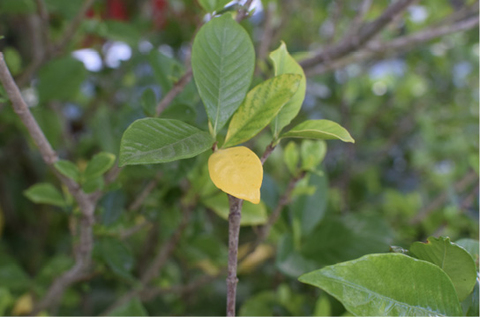
Gardenias require acidic, well-drained soils with a pH between 5.0 and 6.0. Use acidifying fertilizers (such as those formulated for azaleas and camellias) and monitor the soil for iron availability, since gardenias are highly sensitive to micronutrient imbalances. Yellow leaves on new growth is a classic sign of iron deficiency, which occurs when these plants are grown in alkaline or higher pH soils, where iron becomes unavailable even if it is present in the soil.
Pests and Diseases
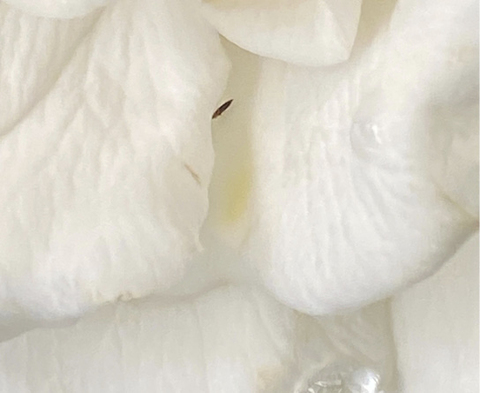
Insect pests that can be problematic with gardenias include whiteflies, scale, spider mites, thrips, and aphids. The presence of black, sooty mold is a sign of honeydew, the excretions of aphids, whiteflies, or certain scale insects. These insects can infest the foliage and stems of the plant. Horticultural oils can help control pest populations. Be sure to apply oils when the temperature is above 45°F and below 90°F, when humidity is below 90 percent, and when the plant is not in direct sunlight to prevent unwanted damage to your shrub.
Synthetic insecticides (acephate, bifenthrin, cyfluthrin, imidacloprid, and lambda cyhalothrin) can also be used to control pest populations. Insecticidal soaps also help control pests but can cause damage to your shrub as gardenias can be sensitive to these soaps. It is best to spot test a small area on the plant and wait 24 hours and see if any damage occurs. Always check the label of the product you are using to ensure it is safe for your plant and can be applied for the pest you are trying to control. Remember, the label is the law.
Thrips can infest both the flowers and foliage of gardenia plants. They are fast-moving, and a heavy infestation can stunt and distort flowers or cause buds to drop prematurely.
Harvest and Postharvest Handling
Gardenia stems should be harvested with at least one flower in bloom. Additional flowers may be in bud or open bloom but should not show brown or tan color, a sign that the flowers are past their prime.
When harvesting, handling, and designing with gardenias, minimize the amount of handling. Hold them by their stems and avoid touching the petals. Bumping or creasing their petals results in bruising, which can render them useless for corsages and bridal bouquets.
Place cut stems in fresh flower food solution that has been mixed according to the manufacturer’s suggestions. Store gardenias at 34°F–38°F and avoid moisture on their petals and leaves, which can lead to gray mold (Botrytis cinerea). Gently package gardenias to avoid bruising. Their expected vase life is 2–4 days. Gardenias are not considered long-storage flowers and are best marketed quickly after harvest.

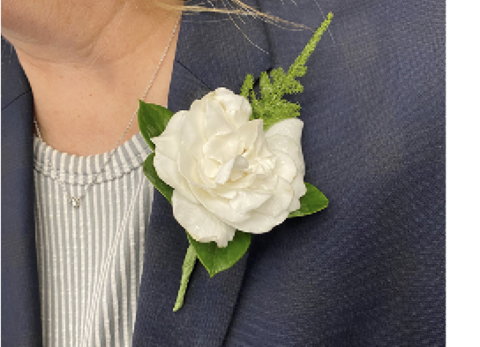
Flowers to Wear: Gardenia Boutonniere
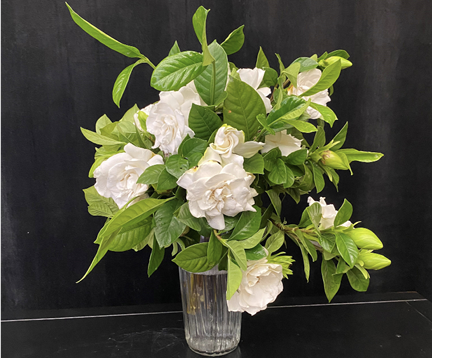
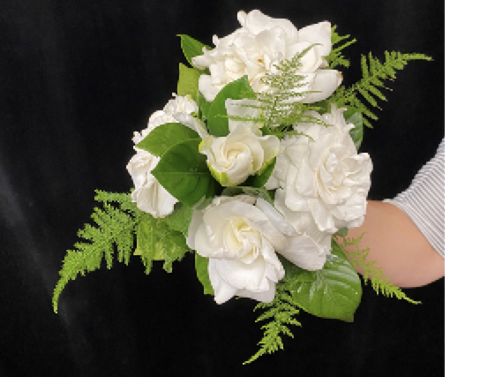
Flowers to Carry: Gardenia Bouquet
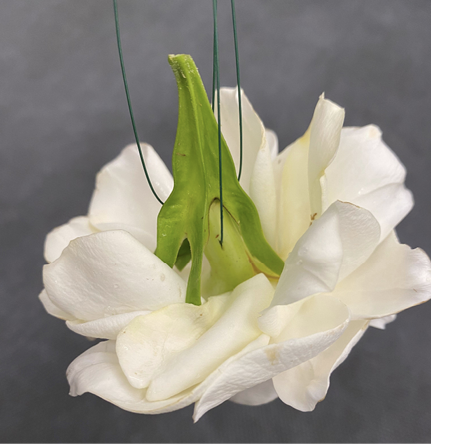
Gardenia Mechanics: Wiring and Taping
Commercial greenhouse gardenia producers use manufactured foliage collars to provide support and protection for individual flowers. The collars are made from vinyl, or from polyester silk leaves or fresh gardenia leaves stapled to a waxed paper disc; a gardenia flower is placed into it. These collars are not used on bunched gardenias but are reserved for large-sized gardenia blossoms.
Farmer florists can collar gardenias by using wired and taped gardenia foliage. Instead of removing healthy leaves from the shrub, use camellia or ivy leaves in their place. Be sure to keep the leaves proportionate to the flower’s size.



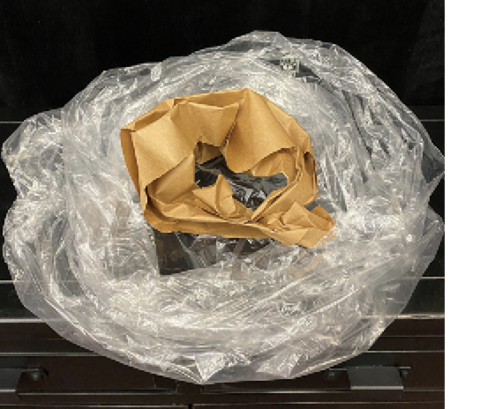
Packaging Gardenia Bouquets
Careful growing and designing with gardenias requires thoughtful packaging to ensure a pristine bouquet. Prepare this packaging to help protect the blooms from bruising, moisture loss, and handling damage. Form brown kraft paper or clean newspaper into a circular collar, then staple the ends to hold the form. Position the collar into the center of an open dry cleaner’s plastic bag.


Summary
Gardenias are a high-value specialty crop that require careful handling. While it may be challenging to track the bloom time and subsequent sales of gardenia flowers, their relatively easy production and boutique appeal make them an enticing floriculture crop.
Consider selling these flowers to retail florists for use at weddings, proms, or in sympathy floral designs. Many customers are happy to allow the farmer florist to choose the freshest, most beautiful flowers available for their events. Imagine the appeal of southern gardenias tucked into bouquets, ceremony flowers, and very special arrangements.
References
Brown, S., & Bradshaw, J. (2024). Gardenias at a glance (EP338). UF/IFAS.
Çelikel, F., Reid, M., & Jiang, C. (2020). Postharvest physiology of cut Gardenia jasminoides flowers. Scientia Horticulturae, 261, Article 108983.
Kluepfel, M., & Polomski, R. F. (2024). Gardenia (HGIC 1065). Clemson Cooperative Extension.
Kobayashi, K., & Kaufman, A. (2006). Common gardenia. Cooperative Extension Service, College of Tropical Agriculture and Human Resources, University of Hawaii at Mānoa.
Scott, J., & Williamson, J. (2024). Gardenia insects and related pests. Clemson Cooperative Extension.
Skelly, J. (2013). Horticultural oils: What a gardener needs to know (FS-13-20). Extension, University of Nevada, Reno.
Williamson, J., Ubl, J. D., & Munnerlyn, C. (2021). Insecticidal soaps for garden pest control (HGIC 2771). Clemson Cooperative Extension.
Publication 4225 (POD-09-26)
By James M. DelPrince, PhD, Associate Professor and Horticulture Specialist; Patricia Knight, PhD, Research Professor, Scott Langlois, Senior Research Associate; and Jenny Ryals, Research Associate, Coastal Research and Extension Center.
The Mississippi State University Extension Service is working to ensure all web content is accessible to all users. If you need assistance accessing any of our content, please email the webteam or call 662-325-2262.
Download
P4225
Gardenias (Gardenia jasminoides) for the Farmer Florist
578.41 KB
Authors
-
 Associate Extension Professor
- CREC-Coastal Research & Ext Center