P2655
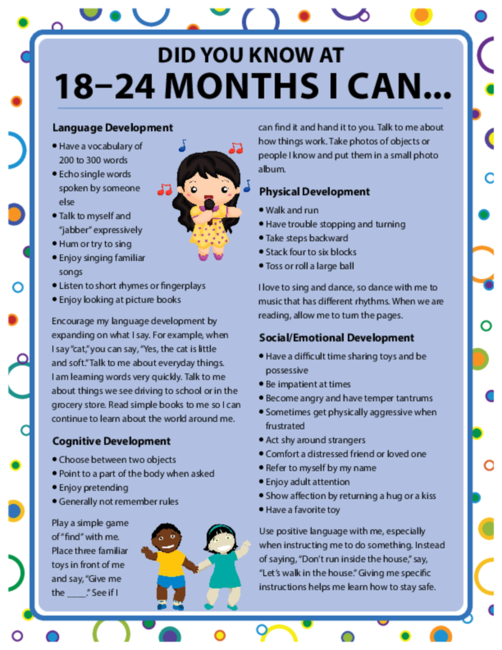
Did You Know at 18-24 Months I Can
Language Development
- Have a vocabulary of 200 to 300 words
- Echo single words spoken by someone else
- Talk to myself and “jabber” expressively
- Hum or try to sing
- Enjoy singing familiar songs
- Listen to short rhymes or fingerplays
- Enjoy looking at picture books
Encourage my language development by expanding on what I say. For example, when I say “cat,” you can say, “Yes, the cat is little and soft.” Talk to me about everyday things. I am learning words very quickly. Talk to me about things we see driving to school or in the grocery store. Read simple books to me so I can continue to learn about the world around me.
Cognitive Development
- Choose between two objects
- Point to a part of the body when asked
- Enjoy pretending
- Generally not remember rules
Play a simple game of “find” with me. Place three familiar toys in front of me and say, “Give me the ____.” See if I can find it and hand it to you. Talk to me about how things work. Take photos of objects or people I know and put them in a small photo album.
Physical Development
- Walk and run
- Have trouble stopping and turning
- Take steps backward
- Stack four to six blocks
- Toss or roll a large ball
I love to sing and dance, so dance with me to music that has different rhythms. When we are reading, allow me to turn the pages.
Social/Emotional Development
- Have a difficult time sharing toys and be possessive
- Be impatient at times
- Become angry and have temper tantrums
- Sometimes get physically aggressive when frustrated
- Act shy around strangers
- Comfort a distressed friend or loved one
- Refer to myself by my name
- Enjoy adult attention
- Show affection by returning a hug or a kiss
- Have a favorite toy
Use positive language with me, especially when instructing me to do something. Instead of saying, “Don’t run inside the house,” say, “Let’s walk in the house.” Giving me specific instructions helps me learn how to stay safe.
Self-Help Skill Development
- Drink from a straw
- Feed myself with a spoon
- Help you wash my hands
- Open cabinets, drawers, and boxes
- Begin to show signs of independence and try to do things alone
Encourage me to play dress-up by providing a full-length mirror on the wall and a dress-up box filled with caps, scarves, and old shoes. Continue to encourage me while I am learning to do things for myself.
I am getting more mobile and curious and learning about my world. Make sure everything is baby-proofed and that I can’t get to dangerous objects and liquids.
Teach me this “Head, Shoulders, Knees, and Toes” fingerplay to help me learn the parts of my body!
(Touch each part of your body as you sing the song.)
Head, shoulders, knees, and toes
Knees and toes
Head, shoulders, knees, and toes
Knees and toes
Eyes and ears and mouth and nose
Head, shoulders, knees, and toes
Knees and toes
Sing “Old MacDonald” with me to help me learn animals and the sounds they make.
Old MacDonald had a farm, E-I-E-I-O.
And on this farm he had a cow, E-I-E-I-O.
With a moo-moo here
And a moo-moo there.
Here a moo, there a moo,
Everywhere a moo-moo.
Old MacDonald had a farm, E-I-E-I-O.
…and on this farm he had a pig...oink-oink...
…and on this farm he had a duck...quack-quack...
…and on this farm he had a sheep...baa-baa...
…and on this farm he had a horse…nah-nah…
Here are some books that I may enjoy:
- Goodnight Gorilla by Peggy Rathmann
- Mr. Brown Can Moo! Can You? by Dr. Seuss
- The Very Quiet Cricket by Eric Carle
- Blue Hat, Green Hat by Sandra Boynton
- Clifford’s Animal Sounds by Norman Bridwell
There are games you can make for me using things from around the house, like a pompom ball drop.
Materials
- paper towel rolls
- plastic bowls
- colorful pompom balls
Instructions
- Tape paper towel rolls to an empty wall in a safe area. They can be taped in any direction.
- Place bowls under the paper towel rolls that will collect the pompom balls when they are dropped.
- Model what do to with the pompoms by dropping them down the rolls into the bowls. I can start color matching by dropping certain colors down the paper towel roll into the bowl of the matching color. I can also help color the paper towel rolls.
A couple of other great toys that will help my development are puzzles and washable crayons and paper. Puzzles are a great way to give me little victories—putting something exactly in place is very satisfying. Choose puzzles that have very few pieces and are made of thick, easy-to-hold blocks of wood. Puzzles with knobs attached to the pieces are especially easy to handle.
You can make your own puzzle out of a large picture, such as a picture from a magazine or calendar. You could even use the front of a familiar cereal box.
- Glue the picture to some poster board or cardboard.
- Cut the picture into puzzle-shaped pieces and laminate the pieces or cover with clear contact paper.
- Trim the extra laminate or contact paper from each piece.
Washable crayons and paper allow me to learn how to make the “up and down” motion of drawing with my entire arm. Right now, I draw better standing up than at a table. Also, I am still learning how to control my scribbles, so I need large pieces of paper. To encourage writing and drawing skills, tape a large piece of paper to a wall and provide just a couple of crayons—too many choices can be overwhelming. As I get older, I can learn to draw with my hand only.
Sleep helps me grow and develop. I should get 11–14 hours of sleep a day.
Safety note: Any toys or materials that can fit inside a paper towel roll can be choking hazards for infants and toddlers. According to the American Academy of Pediatrics, any object handled by young children should be at least 1.25 inches in diameter and 2.25 inches long.
Remember that each child develops at his or her own rate, and this handout is meant only as a guide of what to expect of your child’s development at this age.
For more information about parenting and developmental milestones, contact your county Extension office or visit extension.msstate.edu.
References
American Academy of Pediatrics. (2010). Policy statement—prevention of choking among children.
National Sleep Foundation. (2015). How much sleep do we really need?
Publication 2655 (POD-04-26)
By Louise E. Davis, PhD, former Extension Professor; Elizabeth Thorne, Project Manager; and Michelle Cleveland, Instructor I, Human Sciences.
The Mississippi State University Extension Service is working to ensure all web content is accessible to all users. If you need assistance accessing any of our content, please email the webteam or call 662-325-2262.
Download
P2655
Did You Know at 18-24 Months I Can
401.01 KB
Departments
Authors
-
 Project Manager
- MSU Extension- Early Childhood Prog