M2480-15
Coastal Cleanup Program
Challenges
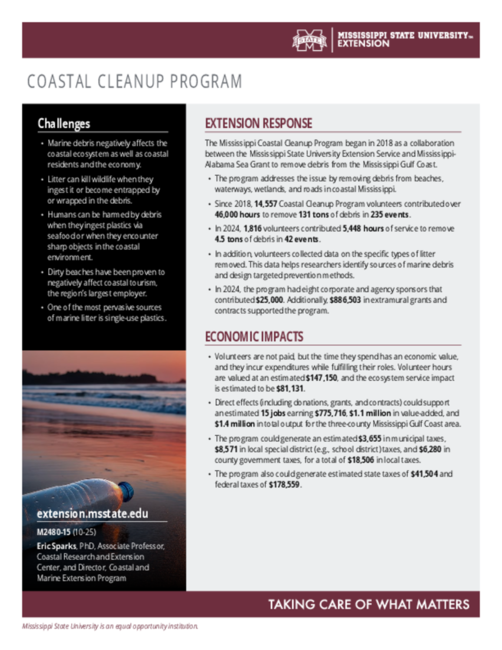
- Marine debris negatively affects the coastal ecosystem as well as coastal residents and the economy.
- Litter can kill wildlife when they ingest it or become entrapped by or wrapped in the debris.
- Humans can be harmed by debris when they ingest plastics via seafood or when they encounter sharp objects in the coastal environment.
- Dirty beaches have been proven to negatively affect coastal tourism, the region’s largest employer.
- One of the most pervasive sources of marine litter is single-use plastics.
Extension Response
The Mississippi Coastal Cleanup Program began in 2018 as a collaboration between the Mississippi State University Extension Service and Mississippi-Alabama Sea Grant to remove debris from the Mississippi Gulf Coast.
- The program addresses the issue by removing debris from beaches, waterways, wetlands, and roads in coastal Mississippi.
- Since 2018, 14,557 Coastal Cleanup Program volunteers contributed over 46,000 hours to remove 131 tons of debris in 235 events.
- In 2024, 1,816 volunteers contributed 5,448 hours of service to remove 4.5 tons of debris in 42 events.
- In addition, volunteers collected data on the specific types of litter removed. This data helps researchers identify sources of marine debris and design targeted prevention methods.
- In 2024, the program had eight corporate and agency sponsors that contributed $25,000. Additionally, $886,503 in extramural grants and contracts supported the program.
Economic Impacts
- Volunteers are not paid, but the time they spend has an economic value, and they incur expenditures while fulfilling their roles. Volunteer hours are valued at an estimated $147,150, and the ecosystem service impact is estimated to be $81,131.
- Direct effects (including donations, grants, and contracts) could support an estimated 15 jobs earning $775,716, $1.1 million in value-added, and $1.4 million in total output for the three-county Mississippi Gulf Coast area.
- The program could generate an estimated $3,655 in municipal taxes, $8,571 in local special district (e.g., school district) taxes, and $6,280 in county government taxes, for a total of $18,506 in local taxes.
- The program also could generate estimated state taxes of $41,504 and federal taxes of $178,559.
M2480-15 (10-25)
Eric Sparks, PhD, Associate Professor, Coastal Research and Extension Center, and Director, Coastal and Marine Extension Program
The Mississippi State University Extension Service is working to ensure all web content is accessible to all users. If you need assistance accessing any of our content, please email the webteam or call 662-325-2262.
Download
M2480-15
Coastal Cleanup Program
153.82 KB
Departments
Authors
-
 Associate Professor & Director
- CREC-Coastal Marine Ext Program