P3461
Bottomland Hardwoods Natural Regeneration Using the Shelterwood System
Download the full publication by selecting the publication image in the right column.
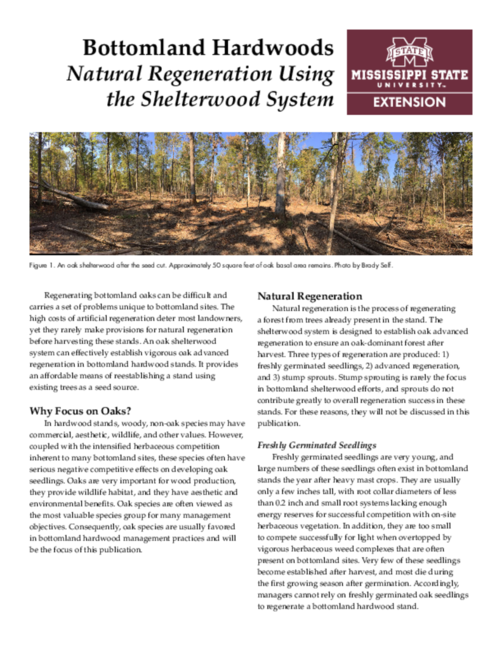
Regenerating bottomland oaks requires establishing strong seedlings before harvesting mature trees. This publication explains how the shelterwood system uses existing oaks as seed sources while managing sunlight and competing vegetation to develop advanced regeneration—well-established seedlings with root systems capable of supporting growth after harvest. Unlike freshly germinated seedlings, which rarely survive intense postharvest competition, advanced regeneration can help maintain a substantial oak component in the next stand. Success depends on suitable seed-producing trees, adequate seedling size and abundance, competition control, and matching oak species to site conditions, which can vary considerably with small changes in elevation, drainage, and soils.
The shelterwood process begins by controlling undesirable midstory trees, followed by partial overstory removal to provide approximately 40 to 60 percent available sunlight while retaining enough shade to suppress herbaceous competition. Managers then monitor oak seedling development before removing the remaining overstory once adequate regeneration averages 3 to 4 feet tall. Establishment commonly takes 2 to 5 years but may require 10 years or longer, and properly implemented treatments can produce more than 1,000 advanced oak seedlings per acre. The goal is a mixed hardwood stand containing at least 40 percent oak rather than a pure oak stand. Careful planning, appropriate competition control, and assistance from a professional forester improve the likelihood of successful regeneration.
You can also contact state Extension specialists or your local Extension office for answers to specific questions.
Publication 3461 (POD-06-26)
By A. Brady Self, PhD, Extension Professor, Forestry.
The Mississippi State University Extension Service is working to ensure all web content is accessible to all users. If you need assistance accessing any of our content, please email the webteam or call 662-325-2262.
Download
P3461
Bottomland Hardwoods Natural Regeneration Using the Shelterwood System
4.89 MB
Departments
Authors
-
 Extension Professor
- Forestry